
A crisis is deepening in India with unqualified alternative medical graduates being considered or allowed to prescribe Allopathic medicines. After a strike threatened by the Allopathic Doctors on 11th of July 2025, the Maharashtra State Government has again rolled back this decision for now.
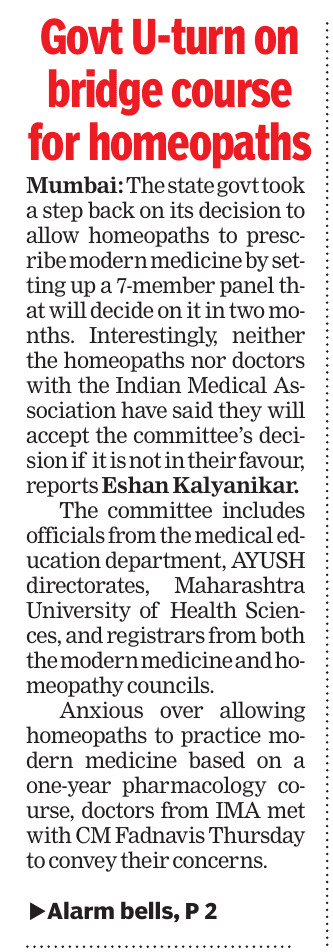
With the state govt now making a U-turn on its decision to allow homeopaths to prescribe modern medicine, IMA (Maharashtra) head, Dr Santosh Kadam, said the case challenges the root cause of the problem — the 2014 amendment to the Maharashtra Homoeopathic Practitioners Act and the Maharashtra Medical Council Act of 1965 — which are still pending before the Bombay High Court. “While the committee can study the subject matter, their decision will not be accepted if it is against public interest. The court’s decision will be final for us. We have faith in the judiciary,” said Dr Kadam.
Maharashtra Homeopathic Council administrator, Bahubali Shah, said, “There is no faith in the committee set up as no homeopath is on it; they have put a clerk instead.”
A day after doctors from IMA met CM Fadnavis, the Maharashtra Medical Council (MMC), which holds the sole authority to register qualified medical professionals, was directed to halt the govt’s earlier directions for the registration of homeopathic practitioners.
In 2017, the Bombay High Court issued a stay on the 2014 amendments that permitted homeopaths to enter modern medicine. The issue remained dormant in the subsequent years until Feb, when medical education minister Hasan Mushrif convened a meeting with health officials and homeopaths. That meeting ultimately led to the June 30 notification from the MMC inviting homeopaths to register with them.
A senior health official close to the matter said, “Last year, the homeopathic council was taken over by an administrator who was involved in the push for the 2014 Act. He has a relationship with the current medical education minister. This is why the issue came back alive.”
The law and judiciary department was soon roped in by the govt for a green signal. TOI asked a top official present in the meeting with Mushrif if there were any concerns expressed by health experts. The official said, “When high authority talks, we cannot speak, and discipline is expected.”
Meanwhile, Shiv Sena (UBT) leader of opposition in the Legislative Council, Ambadas Danve, backed the IMA and called for withdrawal of the notification.
He said, “These are different fields with different curricula. While the government has put a condition of six months of prior training in modern medicine, there is a difference between BHMS doctors and MBBS doctors.”
After doing a lot of research on this issue, I find that at the ground level, there is simply no regulation on dispensing medicines at retail chemists. So, irrespective of the status of the law on prescribing, chemists are still dispensing medicines on incomplete and invalid prescriptions.
So, here are my findings and suggestions:
Guidelines for Dispensing Medicines in Indian Retail Pharmacies

1. Legal and Regulatory Framework
- Only Registered Pharmacists May Dispense: As per the Pharmacy Act, 1948 and Pharmacy Practice Regulations, 2015, only a registered pharmacist is legally permitted to dispense medicines on the prescription of a registered medical practitioner[1][2][3][4].
- Prescription Requirements: Medicines must be dispensed strictly against a valid prescription from a registered medical practitioner. The pharmacist must verify the prescription for completeness, including patient details, drug name, dosage, frequency, and prescriber’s signature[5][6].
- Documentation: Proper records must be maintained for all dispensed medicines, especially for Schedule H, H1, and X drugs, as per the Drugs and Cosmetics Act and Rules[6].
2. Non-Allopathic Practitioners Prescribing Allopathic Medicines
- Legal Status: Non-allopathic practitioners (AYUSH: Ayurveda, Unani, Siddha, Homoeopathy) are generally not permitted to prescribe allopathic medicines unless specifically authorized by a general or special order of the concerned State Government under Rule 2(ee)(iii) of the Drugs and Cosmetics Rules[7][8][9][10][11][12][13].
- Pharmacy Responsibility: Retail pharmacies must verify the prescriber’s qualifications and ensure that allopathic medicines are dispensed only against prescriptions from practitioners legally authorized to prescribe them[1][2][3].
3. Good Dispensing Practices
- Pharmacist’s Role:
- Review each prescription for appropriateness, potential drug interactions, and completeness before dispensing[5][6].
- Personally dispense medicines and provide patient counseling on dosage, administration, and storage[5].
- Patient Counseling: Pharmacists should educate patients on the correct use of medicines, possible side effects, and the importance of adherence to prescribed therapy[5][6].
- Inventory and Storage: Maintain proper inventory records, check for expiry dates, and ensure appropriate storage conditions for all medicines[6].
4. International Standards (JCI Alignment)
- Medication Management: Follow a uniform system for medication dispensing, ensuring the right dose reaches the right patient at the right time[15][16][17].
- Labeling: All dispensed medicines should be clearly labeled with the drug name, dosage, patient name, date of dispensing, and expiration date[15][16].
- Documentation and Traceability: Maintain records of all transactions for accountability and quality assurance[15][17].
- Patient Safety: Implement checks to prevent dispensing errors, including double-checking high-risk medications and providing clear instructions for use[16][17].
5. Recommendations for Policy and Practice
| Area | Guideline |
| Prescriber Verification | Dispense allopathic medicines only on prescriptions from authorized allopathic practitioners[1][2][3][4]. |
| Cross-Pathy Prescriptions | Do not honor allopathic prescriptions from AYUSH practitioners unless state law specifically permits[7][8][10][11][12][13]. |
| Pharmacist’s Duties | Ensure personal review and counseling for every prescription[5][6]. |
| Record Keeping | Maintain detailed records for all dispensed medicines, especially controlled substances[6]. |
| Patient Education | Provide clear instructions and counseling to every patient[5][6]. |
| Compliance with JCI | Align dispensing practices with JCI standards for medication management and safety[15][16][17]. |
6. Key Takeaways for further Discussion
- Strict adherence to legal frameworks is essential to ensure patient safety and professional accountability.
- Pharmacies must not dispense allopathic medicines on prescriptions from non-allopathic practitioners unless explicitly permitted by state law.
- Continuous education and training for pharmacists on legal, ethical, and best practice standards is vital.
- Adoption of international standards (like JCI) can enhance medication safety and quality of care in Indian retail pharmacy practice.
These guidelines are intended to support safe, ethical, and legally compliant dispensing practices in Indian retail pharmacies, with special attention to the complexities introduced by cross-system prescribing.

- https://thc.nic.in/Central Governmental Regulations/Pharmacy Practice Regulations 2015.pdf
- https://www.pci.nic.in/pdf/14-150 amendment web.pdf
- https://pci.gov.in/faqs/
- https://www.pci.nic.in/pharmaact_chapter5.html
- https://ipapharma.org/wp-content/uploads/2019/02/gpp-manua-1.pdf
- https://pmc.ncbi.nlm.nih.gov/articles/PMC4980921/
- https://pmc.ncbi.nlm.nih.gov/articles/PMC5084535/
- https://www.ima-india.org/ima/free-way-page.php?pid=199
- https://sansad.in/getFile/loksabhaquestions/annex/12/AU4207.pdf
- https://pib.gov.in/newsite/erelcontent.aspx?relid=30117
- https://pmc.ncbi.nlm.nih.gov/articles/PMC10635757/
- https://www.springermedizin.de/the-first-aau-international-conference-on-pharmacy-and-biomedica/26126660
- https://www.thieme-connect.com/products/ejournals/abstract/10.1055/s-0043-1772678
- https://www.newindianexpress.com/nation/2022/May/30/nmc-prescribes-new-rules-for-ayush-doctors-2459600.html
- https://www.acibademtechnology.com/docs/JCI_AStore_ENG.PDF
- https://info.jcrinc.com/rs/494-MTZ-066/images/JCI_MMU_Article_September.pdf




 Love, power and a sound mind
Leave a comment