
Warning: Do not read this on your mobile if your kids are around.
Walk into any living room, restaurant, or bedroom tonight, and the scene is identical: the eerie, bluish glow illuminating faces that should be sleeping, laughing, or reading.
I gave my children smartphones and tablets in 2009 thinking I was offering educational tools, convenience, and harmless entertainment.

I was wrong. I handed them engineered dopamine machines built to capture attention at all costs, and our children are paying the price with their health.
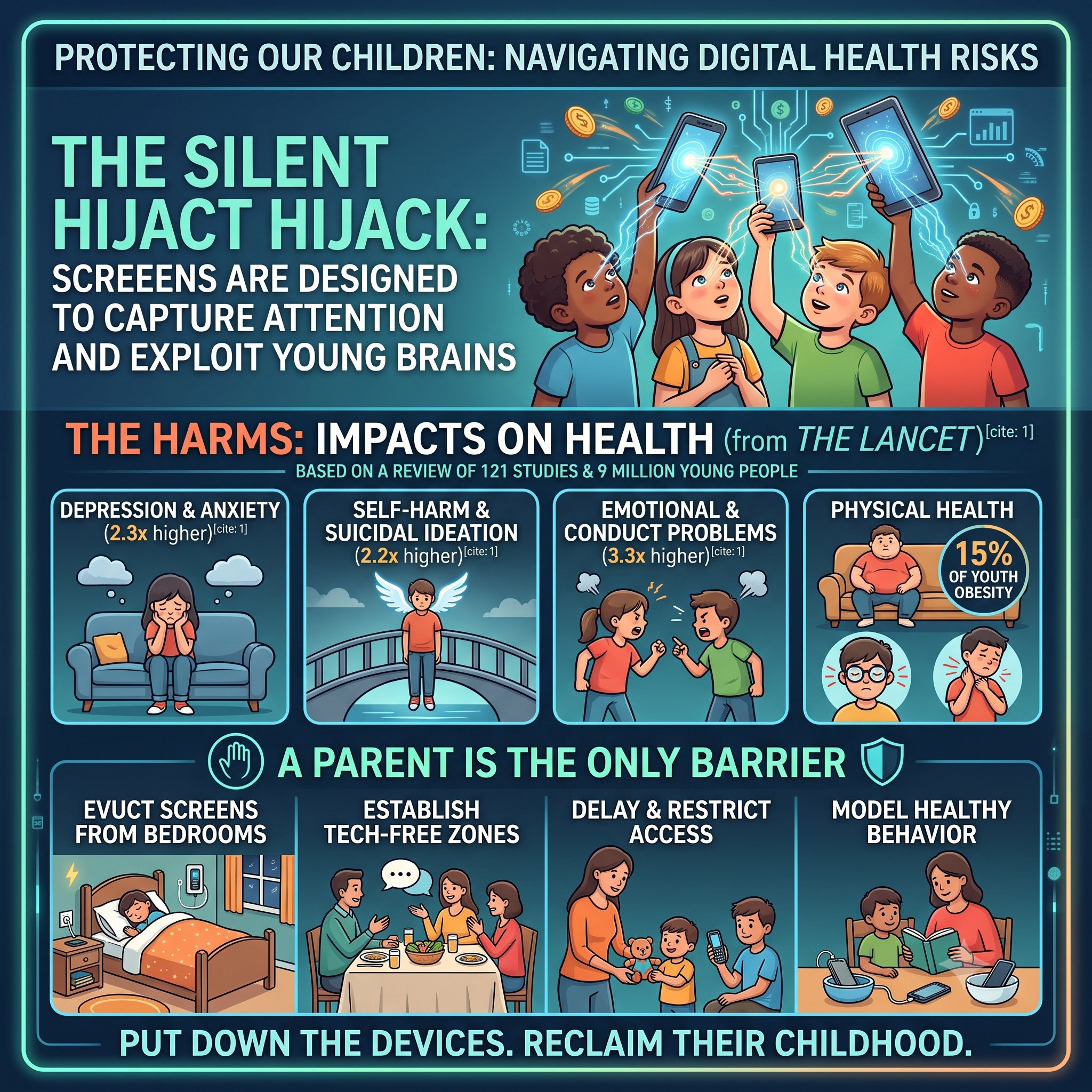
If you think screen time is merely a trivial parenting battle about manners or delayed homework, a massive scientific investigation published in The Lancet in 2026 demands your immediate attention. A landmark umbrella review pooling 121 studies and examining data from over 9 million young people under the age of 25 reveals an alarming reality: compulsive digital media use is driving a catastrophic decline in adolescent physical and mental health.
The Cold, Hard Data: A Generation Under Siege
This is not alarmist rhetoric; it is hard science. Researchers discovered that problematic digital habits—characterized by addiction-like dependency, loss of control, and relentless scrolling—inflict devastating damage across developing minds:
- 2.3 times more likely to suffer from clinical depression and chronic anxiety.
- 2.2 times more likely to engage in self-harm or experience suicidal thoughts.
- 3.3 times more likely to struggle with persistent emotional turbulence and conduct problems.
- Severe sleep deprivation, with children losing vital sleep for every extra hour glued to glowing glass, setting off spirals of irritability, cognitive fog, and metabolic distress.
As Professor Ilona Kickbusch, chair of the Lancet series from the Digital Transformations for Health Lab, bluntly warned: digital tech business models are constructed deliberately to harvest attention and data, leaving young people’s wellbeing as an afterthought.
Our kids are not lacking willpower. They are fighting multi-billion-dollar algorithms engineered by behavioral psychologists and other experts to keep their eyeballs hooked. In that unfair fight, our children lose every single day.
The Physical Rot Behind the Glass
The wreckage isn’t confined to mental health. The companion research highlights that exceeding two hours of daily recreational screen time correlates with 15% of youth obesity cases and widespread spikes in pediatric nearsightedness, chronic migraines, and postural spinal degeneration. By displacing basic physical movement and deep rest, the screen replaces the real world with a sedentary, artificial cage.
Girls are hit especially hard: passive feed scrolling feeds directly into devastating cycles of body dysmorphia, social comparison, and acute loneliness. Even children under five are showing severe behavioural and emotional dysregulation simply because a screen became their electronic pacifier.
Take Back Your Home: Action Over Apathy
Governments and global bodies are being urged to regulate these predatory digital environments, but your child cannot afford to wait years for international policy reform. You as a parent are the only barrier standing between your child and an algorithm designed to exploit them.
- Evict screens from bedrooms completely. Nighttime device use ruins melatonin production and starves the developing brain of restorative sleep. Charge all phones, tablets, and gaming consoles in a common area past 8:00 PM.
- Establish non-negotiable tech-free zones. Just as society banned smoking indoors, ban devices at the dinner table and during family outings. Reclaim human conversation.
- Delay and restrict. Delay personal smartphone ownership and unrestricted social media access as long as humanly possible.
- Be the model. Children emulate what they see. If your phone is glued to your hand during every quiet moment, they learn that reality is optional.
The evidence is in, and the warning siren has sounded. Put down the devices, pull your children out of the algorithmic trance, and reclaim their childhood before it vanishes for good.






Leave a Reply