
We live in a culture that deeply values academic excellence. In urban India, it is entirely common to see a seven-year-old expertly navigating an iPad, or a middle-schooler using ChatGPT to finish their history essay. We often praise this as “digital literacy.”
But a striking new policy from one of the world’s most digitally advanced nations should make us pause and re-examine this trajectory.
Norway has announced a strict, sweeping ban on generative AI tools for elementary school children (grades 1 to 7, ages 6 to 13). As Norwegian Prime Minister Jonas Gahr Stoere puts it, over-reliance on AI allows children to bypass the foundational struggles of education.

Instead, schools are being ordered to return to the core fundamentals: teaching children how to read, write, and do mathematics without digital crutches.
For Indian parents, educators, and mental health professionals, this is a profound moment for introspection. Our current educational landscape is rapidly digitizing, driven by a fear of missing out (FOMO) on the AI revolution. Yet, Norway’s decision tells us that the global vanguard of technology is consciously pulling the emergency brake.
Shortcuts Delete Critical Cognitive Steps
For educators, the Norwegian policy highlights a fundamental truth about human learning: the friction is the education. When a 9-year-old struggles to structure a sentence, summarize a paragraph, or solve a long division problem, their brain is building critical neural pathways. They are learning working memory, logical sequencing, and problem-solving.
When generative AI instantly produces that essay or answers that math problem, the child is not learning to think; they are simply learning to delegate.
In a country like India, where rote learning is already a systemic challenge, introducing generative AI at an early age risks wiping out foundational cognitive development entirely. It replaces deep learning with superficial, algorithmic outputs.
The Screen Crisis: A Lesson in Mental Health
For mental health experts and parents, Norway’s decision is part of a broader, highly successful tech-detox strategy. Norway banned smartphones from classrooms, and the ripple effects were staggering:
- Fewer instances of bullying in schools.
- Higher academic grades across demographics.
- A sharp decline in psychological visits for anxiety and mental health struggles, particularly among young girls.
In India, we are currently witnessing a parallel surge in childhood anxiety, attention deficits, and cyberbullying. Yet, our homes and schools often lean further into screens to keep children occupied or “ahead of the curve.” Norway’s data proves that protecting childhood from hyper-connectivity isn’t regressive—it is a prerequisite for psychological resilience.
Reclaiming Balance: The Road Ahead
This is not a call to banish technology forever. Norway’s policy is nuanced: teens aged 14 to 16 can use generative AI under strict teacher supervision, and those 17 and older are encouraged to use it independently. It treats AI like driving a car—a powerful tool that requires cognitive maturity, supervision, and a solid foundation before you take the wheel.
As an absolute priority, we must shift our perspective:
- Parents: Delay access to personal AI companions and conversational chatbots. Focus instead on physical books, manual handwriting, and unstructured outdoor play.
- Teachers: Pivot assessments away from typed homework that can be easily generated by text models. Prioritize oral presentations, handwritten classroom journals, and real-time collaborative problem-solving.
- Mental Health Professionals: Actively advocate for digital boundaries, helping families recognize that cognitive patience is the best antidote to algorithmic instant-gratification.
Let us look at Norway not as an outlier, but as a roadmap. Before we teach our children to prompt a machine, we must ensure they have learned how to think for themselves. Here is a solution:
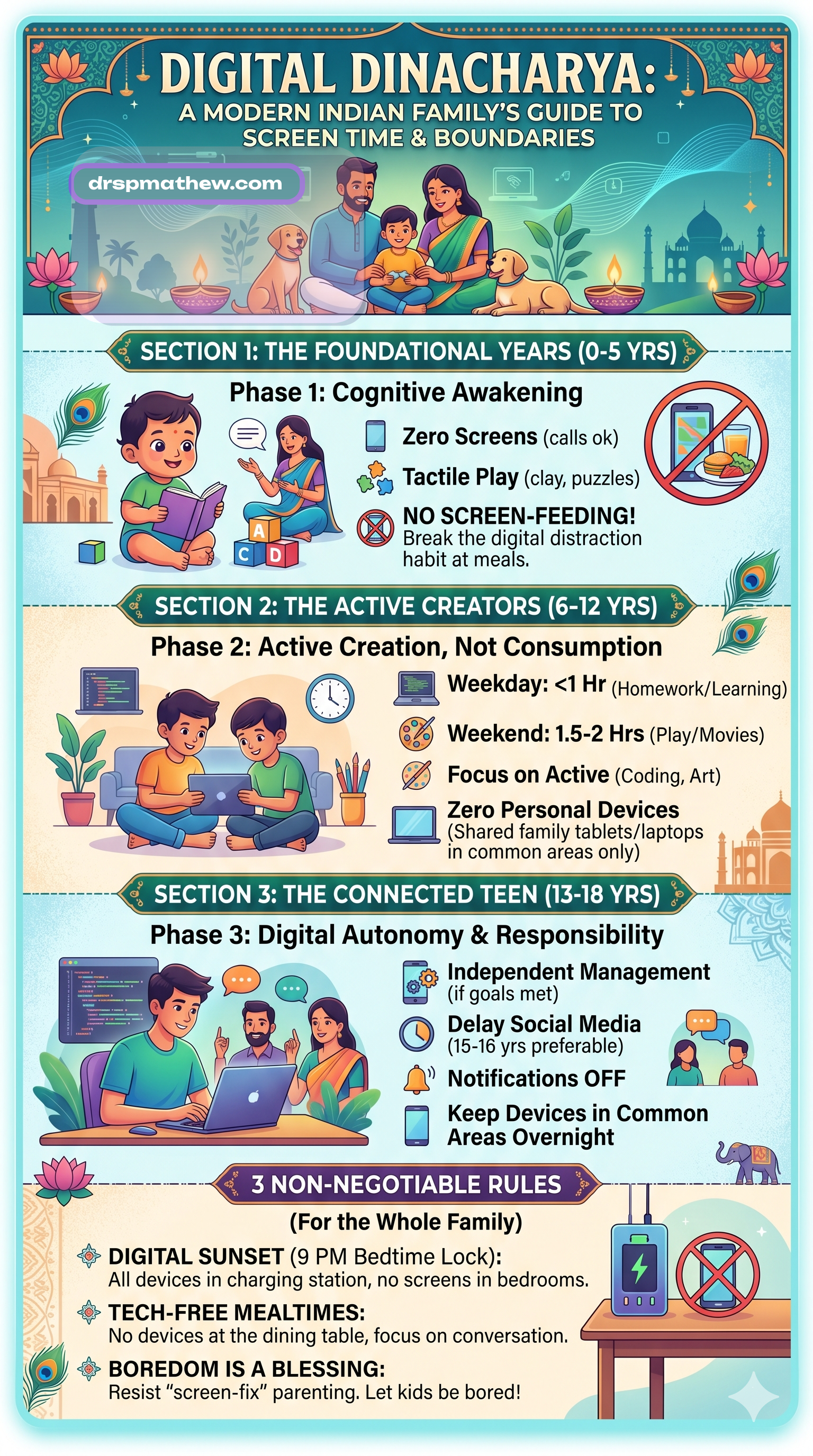
The “Digital Dinacharya” (Daily Rhythm) Framework
A Balanced Tech Guide for Modern Indian Families (2026)

In Indian households, technology often blurs the lines of shared family spaces. From the television playing during family dinners to toddlers eating meals while glued to a smartphone (“screen feeding”), digital habits have deeply penetrated our homes.
This framework is designed to help parents transition from a culture of reactive screen-time (using devices as a digital babysitter) to intentional screen-time (using devices as a deliberate tool).
Phase 1: The Foundational Years (Ages 0 – 5)
The Goal: Uncompromised Neurological & Physical Growth
At this stage, a child’s brain is rapidly building neural pathways through sensory engagement—touching, tasting, seeing, and moving in the physical world. Screen use during this stage can delay speech, shorten attention spans, and disrupt natural motor development.
- Screen-Time Allowance: Zero screens (except for occasional video calls with grandparents/extended family, lasting under 10–15 minutes).
- The “No-Screen Feeding” Rule: Breaking the habit of feeding toddlers while a phone or TV is running is critical. If a child eats only when distracted by a screen, they lose touch with their body’s natural satiety cues, laying the groundwork for unhealthy eating habits.
- Alternative Engagement: Lean heavily into traditional, tactile play. Use building blocks, playdough, drawing, and interactive storytelling (“Dadi-Nani” style tales). If you need to keep a child occupied while cooking, set up a safe space in the kitchen with safe steel utensils, plastic bowls, and spoons for sensory play.
Phase 2: The Cognitive Awakening (Ages 6 – 12)
The Goal: Active Creation Over Passive Consumption
As children enter school, digital exposure becomes inevitable. The objective here is to prevent screens from becoming a dopamine-fueled escape hatch from boredom, homework, or emotional discomfort.
- Screen-Time Allowance: Maximum 1 hour per day on weekdays (strictly for homework/educational purposes); up to 1.5–2 hours on weekends (for entertainment/gaming).
- The “Passive vs. Active” Filter: Categorize tech use.
- Passive (Discouraged): Scrolling short-form videos (YouTube Shorts, Instagram Reels) and endless scrolling gaming apps.
- Active (Encouraged): Coding blocks (like Scratch), learning a digital musical instrument, graphic design, or watching curated, high-quality science/history documentaries.
- Device Ownership: Zero personal devices. Tablets and laptops must remain shared family property kept in common areas (like the living room or dining area), never in the child’s bedroom.
- Alternative Engagement: Enroll them in physical sports, swimming, or classical arts/music. Ensure they experience “productive boredom,” which forces them to pick up a book, draw, or invent a game.
Phase 3: The Connected Teen (Ages 13 – 18)
The Goal: Digital Autonomy with Strict Structural Boundaries
Teens use technology for socializing, identity formation, and complex academic work. Outright bans will backfire and cause rebellion; instead, focus on co-creating rules and fostering digital critical thinking.
- Screen-Time Allowance: Independent management, provided schoolwork, physical activity, and sleep hygiene are consistently maintained.
- The Social Media Pact: Delay personal social media accounts as close to age 15–16 as possible. When they do join, have an open agreement: the parent must have access to privacy settings, and notifications must be turned off to prevent algorithmic hijacking.
- Alternative Engagement: Family board game nights, weekend treks or sports outings, and involving them in adult household responsibilities (grocery shopping, budgeting, event planning) to keep them anchored in reality.
3 Non-Negotiable Rules for the Entire Household (Parents Included)
A framework only works if parents model the behavior. Children learn far more from what we do than what we say.
- The “Ghar Ki Laxmi” (Kitchen/Dining) Tech Ban: No devices are allowed at the dining table during breakfast, lunch, or dinner. Meals must be a sacred time for conversation, catching up, and mindful eating.
- The Digital Sunset (9:00 PM Bedtime Lock): All devices—including parents’ smartphones—go into a designated charging station in the living room at least one hour before bed. No screens are allowed inside bedrooms overnight to protect deep sleep cycles and mental health.
- The “Boredom is a Blessing” Policy: Do not instantly hand over a smartphone when your child complains of boredom during long car rides, at restaurants, or on a rainy afternoon. Allow them to be bored. Boredom is the precise psychological space where creativity, daydreaming, and self-reflection are born.






Leave a Reply